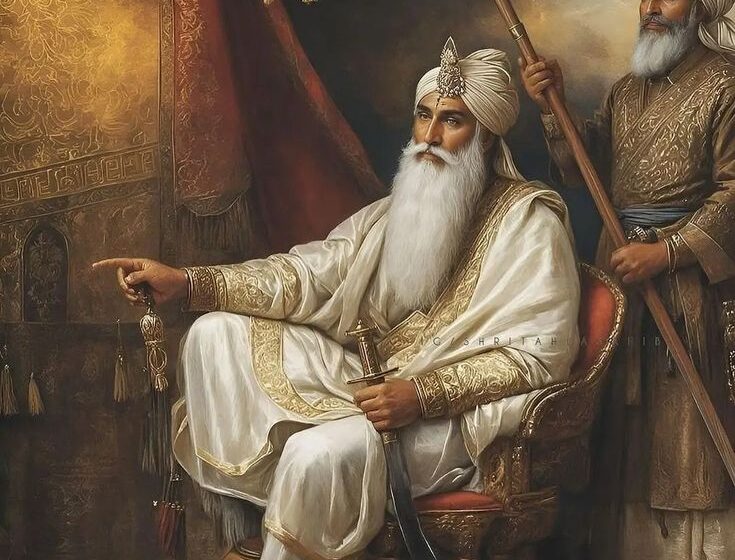

Biography of Maharaja Ranjit Singh
Maharaja Ranjit Singh was born in Gujranwala (present-day Pakistan) on November 13, 1780. His father’s name was Sardar Maha Singh,He united the scattered Sikh Misls to form a powerful Sikh Empire and made Punjab a strong, prosperous and secure state.Ranjit Singh contracted smallpox in his childhood, which caused him to lose vision in his left eye.But this physical weakness never hindered his confidence or leadership ability.After his father’s death, when Ranjit Singh was only 12 years old, he took over the responsibility of the Misl.He learned Gurmukhi, Persian, and the art of warfare. He was adept at horsemanship, swordsmanship, and strategy from childhood.
Unification of Sikh Misls
Due to internal conflicts and weak leadership, Punjab was becoming a victim of external attacks.By the end of the 18th century, the Punjab region was divided into several Sikh misls.
- Ended the internecine wars
- established a strong central authority
- united the Sikh Misls
Capture of Lahore and establishment of the Sikh Empire
Lahore was the most important political and cultural centre of Punjab at that time.In 1799, Ranjit Singh captured Lahore.Subsequently, in 1801, he assumed the title of Maharaja, and with this the Sikh Empire was formally established.Ranjit Singh’s greatest achievement was that he united the scattered Sikh misls and laid the foundation of a strong central rule.His court had Sikhs as well as Hindu and Muslim officials holding high positions.Maharaja Ranjit Singh, despite being a staunch Sikh, respected all religions.
Military power of Raja Ranjit Singh
Maharaja Ranjit Singh’s army was one of the most organized and modern armies of that time.His army had very strong infantry, cavalry and artillery.
Organization of army
- Discipline and regular pay system
- Fauj-e-Khas: A contingent of specially trained soldiers
- Modern weapons and artillery
Ranjit Singh himself was present on the battlefield and boosted the morale of the soldiers.Ranjit Singh gradually faced all these challenges with his intelligence and strategy.
Administrative law
Maharaja Ranjit Singh’s administration was secular, with Sikhs, Hindus, and Muslim officials holding high positions in his court.
Justice and tax system
- Justice was swift and fair
- Farmers were not taxed excessively
- Strict but just punishment for criminals
Ranjit Singh believed that the strength of the state lay in the prosperity of the people.
Legacy of Maharaja Ranjit Singh
Maharaja Ranjit Singh is still known as king of punjab . His legacy is not limited to an empire, but rather, he exemplified the ideals of governance, tolerance, and unity.
Major Contribution
- Strong military and administrative infrastructure
- Establishment of Sikh Empire
- secular governance
Maharaja Ranjit Singh himself was a follower of Sikhism.He never associated the state with religious fanaticism and gave equal respect to all religions.
Beautification of the Golden Temple
The Harmandir Sahib (Golden Temple) in Amritsar was gilded under the patronage of Maharaja Ranjit Singh, which is why it is known today as the Golden Temple.Mosques, gurdwaras and temples enjoyed state patronage